Amazon FBA Wholesale Distributors: How to Source in Bulk (2026 Guide)
Amazon FBA wholesale looks simple from the outside: find a product already selling on Amazon, buy it below retail price, send inventory to FBA, and earn the difference.
The difficult part is everything between “find a product” and “place the order.”
A cheap supplier is useless if the products cannot be authenticated. A popular ASIN is useless if Amazon fees destroy the margin. And a distributor offering hundreds of brands is not necessarily a good sourcing partner if you cannot establish a clean supply chain.
Successful wholesale sourcing therefore starts with the distributor, documentation, product economics, and repeatability—not simply the lowest unit price.
For sellers who want a broader understanding of finding, comparing, and verifying suppliers beyond Amazon, our [Wholesale Suppliers for Resellers] guide covers the wider wholesale sourcing process for USA resellers.
This guide goes deeper into one specific part of that process: how to find Amazon FBA wholesale distributors, evaluate bulk inventory, and build a sourcing process designed for Amazon sellers in 2026.
1. What Are Amazon FBA Wholesale Distributors?
Amazon FBA wholesale distributors are businesses that supply products in bulk to retailers and resellers who may then sell those products through Amazon.
Instead of developing a new private-label product, wholesale sellers generally source existing products from brands, manufacturers, or distributors and resell them.
A typical supply chain can look like:
Brand/Manufacturer → Authorized Distributor → Amazon Seller → Amazon FBA → Customer
This distinction matters.
For branded products, Amazon advises sellers to source directly from the brand or one of its direct distributors and, when using a wholesaler or distributor, validate that supplier’s relationship with the brand. Amazon may also request sourcing documentation.
Distributor vs Wholesaler vs Manufacturer
| Source | What It Does | Typical Advantage | Best Fit |
|---|---|---|---|
| Manufacturer | Produces the product | Direct supply chain | Large-volume buyers |
| Brand | Owns the branded product | Strong authenticity trail | Established wholesale sellers |
| Distributor | Distributes products for brands/manufacturers | Access to multiple products | Amazon wholesale sellers |
| Wholesaler | Sells inventory in bulk | Broad selection | Resellers and smaller buyers |
The label alone should never determine whether you trust a company. A business calling itself a “wholesale distributor” does not automatically mean it has a direct or verifiable relationship with the brands it sells.
That relationship needs to be checked before committing significant capital.
2. Why Supplier Selection Matters More on Amazon FBA
A normal reseller primarily worries about buying low enough to resell profitably.
An Amazon FBA seller has additional problems to solve.
You need to know whether:
- the product can be sold on your account;
- the supplier and supply chain are legitimate;
- documentation is available if Amazon requests it;
- the ASIN has enough demand;
- competition leaves room for another seller;
- the Buy Box price supports your costs;
- FBA fees leave an acceptable margin;
- inventory can be replenished consistently.
Amazon states that some products require approval and sellers may need an invoice from a manufacturer or distributor or authorization from the brand. Amazon also recommends retaining purchase invoices as evidence of authenticity.
That makes supplier quality part of account risk management—not merely purchasing.
3. How to Find Wholesale Distributors for Amazon FBA
Finding suppliers is easy.
Finding suppliers worth opening an account with is harder.
Instead of searching only for phrases such as “cheap wholesale products,” use sourcing queries that reveal businesses positioned closer to the legitimate supply chain.
Examples include:
- Amazon FBA wholesale distributors in the USA
- Wholesale suppliers for Amazon sellers
- Authorized distributors for Amazon FBA
- Wholesale suppliers with Amazon invoices
- Amazon-approved wholesale suppliers
- Bulk suppliers for Amazon sellers
- Brand authorized distributors for Amazon
- Wholesale distributors with low minimum orders
- USA distributors for Amazon wholesale products
- Reliable wholesale sources for Amazon FBA
You can also discover potential suppliers through brands themselves, trade shows, industry associations, manufacturer directories, and established B2B networks.
Start With the Brand and Work Backward
For branded inventory, one of the strongest approaches is surprisingly simple:
Identify the brand first, then determine who distributes it.
Visit the brand’s official website and look for sections such as:
- Dealers
- Distributors
- Wholesale
- Retail Partners
- Become a Retailer
- Dealer Application
If that information is not public, contact the brand and ask which distributors serve your region.
This removes a huge amount of guesswork.
4. How to Verify an Amazon FBA Wholesale Supplier Before Ordering
Do not place a large wholesale order because a website looks professional.
Verify the business first.
Amazon’s responsible-sourcing guidance specifically recommends validating suppliers and, for branded products, checking the wholesaler or distributor’s relationship with the brand.
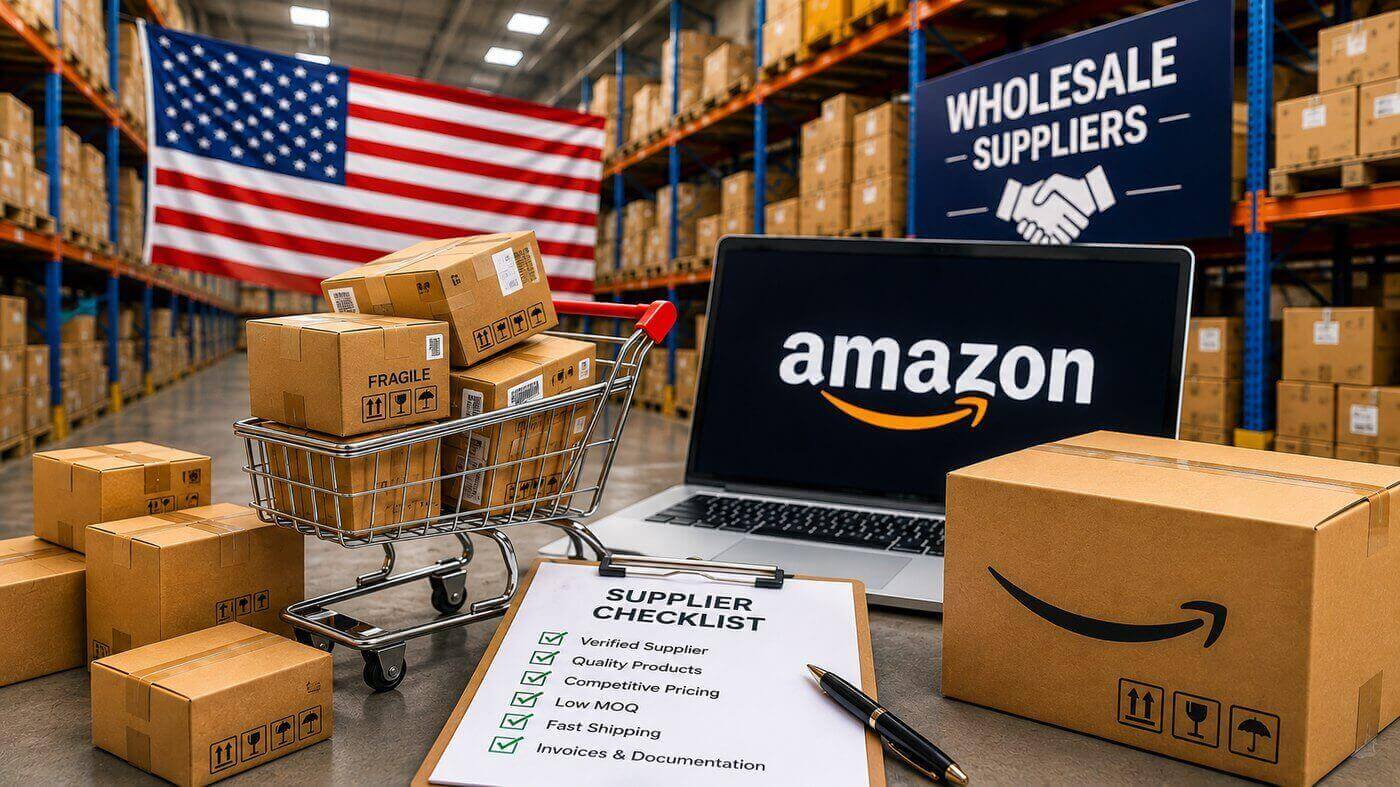
Supplier Verification Checklist
Before opening a wholesale account, check:
- Legal business name
- Physical business address
- Working phone number
- Professional domain email
- Business website
- Years in operation where verifiable
- Brand relationships
- Product catalog
- Return policy
- Shipping terms
- MOQ requirements
- Invoice format
- Payment terms
- Whether products are new and authentic
- Whether the supplier can provide supply-chain documentation when necessary
If you are buying branded inventory, ask a direct question:
Are you an authorized distributor or direct wholesale partner for this brand?
Then verify the answer independently where possible.
Red Flags
Be cautious when a supplier:
- refuses to disclose basic business information;
- only communicates through informal messaging accounts;
- offers branded goods at implausibly low prices;
- cannot explain where its inventory comes from;
- refuses to provide normal commercial invoices;
- uses inconsistent company names or addresses;
- pressures you into a large first order;
- cannot be independently verified.
A low price does not compensate for a weak supply chain.
5. What Amazon FBA Sellers Should Check on Supplier Invoices
Invoices are one of the most important pieces of the wholesale sourcing process.
Amazon wholesale business guide says invoices used for certain product approvals should include supplier information, an itemized product list, a recent date, seller details matching the selling account, manufacturer or distributor details, and the required purchase quantity. Amazon’s example guidance currently references a combined purchase of at least 10 units for that approval context.
Requirements can vary depending on the specific review, category, brand, ASIN, or policy issue, so sellers should check the exact request shown in Seller Central rather than assuming one invoice rule applies everywhere.
For responsible-sourcing reviews, Amazon may expect documentation capable of demonstrating the product’s supply chain and may contact suppliers or manufacturers for verification.
Invoice Checklist
A strong commercial invoice should clearly identify:
| Invoice Element | Why It Matters |
|---|---|
| Supplier business information | Helps identify and verify the source |
| Buyer business information | Connects the purchase to your business |
| Invoice date | Establishes when inventory was purchased |
| Product identifiers | Helps connect inventory to the relevant product |
| Quantities | Documents purchased inventory |
| Completed transaction | Shows an actual purchase rather than a quotation |
| Supplier contact details | Allows verification when required |
Amazon has also stated that altered documents, quotes, pro-forma invoices, and documents that do not represent completed transactions may not be accepted in certain policy reviews.
Practical rule: treat documentation as part of the product—not paperwork you worry about after inventory has already been purchased.
6. How to Analyze a Wholesale Product Before Buying in Bulk
Getting approved by a distributor does not mean you should buy everything in its catalog.
The next stage is product analysis.
For every potential ASIN, evaluate four things:
Demand + Competition + Costs + Risk
Demand
Look at whether the product appears to sell consistently rather than reacting to a short-lived spike.
Evaluate:
- sales history;
- price history;
- seasonality;
- category demand;
- number of competing offers;
- stock patterns.
Competition
A product can sell thousands of units and still be a terrible wholesale opportunity if too many sellers are fighting for the same sales.
Check:
- current FBA seller count;
- whether Amazon itself sells the product;
- Buy Box competition;
- seller ratings;
- price stability;
- whether new sellers continuously enter the listing.
Product Restrictions
Before paying a supplier, confirm whether your seller account can actually list the product.
A strong margin means nothing if the inventory arrives and your account cannot sell the ASIN.
Supply
Ask whether the distributor can replenish the product.
Wholesale becomes much more valuable when you can reorder a profitable ASIN instead of constantly searching for replacements.
7. Calculate the Real FBA Margin Before Placing a Bulk Order
This is where weak wholesale sourcing strategies collapse.
Do not calculate profit as:
Amazon Selling Price − Wholesale Cost = Profit
That number is incomplete.
Your actual calculation needs to account for costs such as:
Selling Price
− Product Cost
− Amazon Referral Fee
− FBA Fulfillment Costs
− Inbound Shipping
− Prep/Labeling Costs
− Storage Costs
− Other Applicable Costs
= Estimated Profit
Amazon provides a Revenue Calculator that allows sellers to estimate selling fees, FBA costs, costs, and revenue before making inventory decisions.
Example
Suppose a distributor offers a product for $12 per unit and the current Amazon price is $29.99.
The $17.99 difference is not your profit.
If the combined Amazon, fulfillment, shipping, and preparation costs were hypothetically $10, your estimated profit would be:
$29.99 − $12 − $10 = $7.99
That example is deliberately simplified. Actual costs depend on the product, dimensions, weight, category, fulfillment method, storage situation, and other factors.
Run the real numbers for the specific ASIN before purchasing.
8. MOQ vs Profitability: Do Not Let Bulk Pricing Trap You
MOQ means Minimum Order Quantity.
A distributor might offer:
| Order Quantity | Example Unit Cost |
|---|---|
| 24 units | $14.00 |
| 48 units | $12.75 |
| 100 units | $11.50 |
| 500 units | $9.90 |
The 500-unit price looks attractive.
It can also be the worst option.
If demand slows, competition increases, or the Amazon selling price falls, you are now holding hundreds of units of a bad purchase.
For a new supplier or untested ASIN, smaller opening orders usually provide more information with less capital exposure.
You are testing two things simultaneously:
the product and the supplier.
Once both prove reliable, larger bulk orders become easier to justify.
9. Questions to Ask a Wholesale Distributor Before Opening an Account
Do not send:
“Hi, send me your price list.”
That makes you look like every low-effort lead in their inbox.
Approach the distributor like a retailer building a purchasing relationship.
Ask:
- What is your minimum opening order?
- Do you have minimum quantities per SKU?
- Which brands are you authorized to distribute?
- Can you provide a wholesale catalog or price list?
- Do you offer volume pricing?
- What are your payment terms?
- What are your standard lead times?
- Do you provide UPC/EAN information?
- What is your return or damaged-goods policy?
- Can you ship directly to an Amazon FBA prep facility?
- Do you provide standard commercial invoices?
- How frequently is inventory replenished?
These questions reveal far more than price alone.
10. Direct-to-FBA vs Shipping Inventory to Yourself
Once you place an order, inventory needs to move from the distributor into Amazon’s fulfillment network.
There are several possible workflows.
Option 1: Distributor → Your Location → Amazon FBA
You receive the inventory first.
Advantages
- inspect product condition;
- verify quantities;
- identify damaged inventory;
- control labeling and preparation.
Disadvantages
- additional handling;
- more time;
- potentially another shipping cost.
Option 2: Distributor → Prep Center → Amazon FBA
A third-party prep operation receives and prepares the products.
This can work well for sellers operating remotely or processing larger order volumes.
Option 3: Distributor → Amazon FBA
Some distributors may support direct shipping into the FBA workflow.
This can reduce handling but requires strong coordination. Packaging, labeling, shipment preparation, and Amazon requirements still need to be correct.
For a new supplier, sending inventory blindly to FBA before establishing quality consistency can create unnecessary risk.
11. Domestic vs Overseas Wholesale Distributors for Amazon FBA
Not every cheap source is the best FBA source.
| Factor | USA Distributor | Overseas Supplier |
|---|---|---|
| Typical lead time | Shorter | Longer |
| Reordering | Easier | More planning required |
| Freight complexity | Lower | Higher |
| Import considerations | Lower | Higher |
| Communication | Often easier for US sellers | Varies |
| Unit cost | Can be higher | Can be lower |
| Branded wholesale sourcing | Often better suited | Depends heavily on supply chain |
For traditional branded Amazon wholesale, domestic distributors can offer major advantages because replenishment and supply-chain verification may be simpler.
Overseas sourcing can make more sense for other business models, particularly manufacturing or private-label products.
Do not choose based solely on unit cost.
Choose based on landed cost + documentation + lead time + reliability + margin.
12. A Practical Amazon FBA Bulk-Sourcing Workflow
Instead of randomly contacting hundreds of suppliers, build a repeatable process.
Step 1: Choose a Product Category
Start with categories you understand or can analyze confidently.
Step 2: Build a Supplier List
Find manufacturers, brands, authorized distributors, and legitimate wholesale suppliers operating in that category.
Step 3: Verify the Supplier
Check the business and its relationship with the products or brands being offered.
Step 4: Open a Wholesale Account
Provide legitimate business information and any documents the distributor requires.
Step 5: Obtain the Catalog
Get the product catalog, wholesale price list, MOQ requirements, and shipping terms.
Step 6: Match Products to Amazon
Identify corresponding products/ASINs carefully.
Step 7: Check Selling Eligibility
Confirm your account can sell the product before committing money.
Step 8: Analyze Demand and Competition
Do not buy based solely on the current selling price.
Step 9: Calculate FBA Economics
Use current Amazon fee information and calculate the estimated landed cost and profit.
Step 10: Place a Controlled First Order
Do not overbuy simply to unlock a slightly lower unit cost.
Step 11: Track Performance
Measure:
- sell-through;
- actual margin;
- price movement;
- returns;
- storage;
- replenishment speed.
Step 12: Reorder Winners
The goal is not to find one profitable shipment.
The goal is to develop replenishable wholesale inventory.
13. Common Amazon FBA Wholesale Sourcing Mistakes
Buying Before Checking Eligibility
This is one of the fastest ways to turn cash into stranded inventory.
Check first.
Choosing the Cheapest Distributor
Cheap inventory from an unverifiable source can create far bigger problems than the money saved.
Ignoring FBA Fees
Revenue is not profit.
Calculate the full cost before ordering.
Ordering Too Much Too Early
Bulk discounts feel profitable before inventory is purchased.
Unsold stock makes them expensive afterward.
Ignoring Price History
Today’s Buy Box price does not guarantee next month’s selling price.
Depending on One Supplier
A single supplier creates a single point of failure.
Build alternative sourcing relationships as the business grows.
Treating Invoices as an Afterthought
For Amazon wholesale, sourcing documentation needs to be considered before the purchase, not after a problem occurs.
14. How to Build a Scalable FBA Wholesale Supplier Network
The strongest Amazon wholesale operation is not built around one lucky product.
It is built around supplier relationships.
Think in layers:
Level 1: Find legitimate suppliers
Level 2: Open wholesale accounts
Level 3: Analyze catalogs
Level 4: Test profitable ASINs
Level 5: Reorder proven inventory
Level 6: Negotiate better terms
Level 7: Add additional distributors and brands
As your purchasing history grows, you may be able to negotiate:
- lower unit prices;
- larger volume discounts;
- better payment terms;
- faster order processing;
- access to additional inventory;
- improved shipping arrangements.
This is why serious wholesale sellers focus on repeatable sourcing rather than constantly hunting random clearance deals.
15. Amazon FBA Wholesale Distributor Checklist
Before sending payment for a bulk order, run through this final checklist:
Supplier
- Business verified
- Contact information verified
- Brand relationship checked where applicable
- Commercial invoices available
- Return policy reviewed
Product
- Correct ASIN identified
- Selling eligibility checked
- Demand reviewed
- Competition reviewed
- Price history reviewed
- Restrictions considered
Financials
- Wholesale unit cost calculated
- Shipping included
- Prep costs included
- Amazon fees estimated
- Margin calculated
- ROI assessed
- Worst-case price drop considered
Inventory
- MOQ is manageable
- First order is controlled
- Lead time known
- Replenishment availability confirmed
- FBA preparation plan established
If several of these answers are unknown, you are not ready to place a large order.
Frequently Asked Questions
How do I find wholesale distributors for Amazon FBA?
Start with brands and manufacturers in your target category, identify their direct or authorized distributors where possible, and then evaluate wholesale directories, industry contacts, trade shows, and B2B suppliers. Verify the supplier before purchasing branded inventory.
Can I buy wholesale products and sell them on Amazon?
Wholesale resale is possible, but your account must be eligible to sell the relevant products and you remain responsible for Amazon policies, applicable laws, product authenticity, and sourcing documentation. Some products, categories, or brands may require approval.
Does Amazon accept wholesale invoices?
Amazon may use invoices as sourcing or approval documentation, but the exact requirements depend on the situation. Supplier details, buyer information, itemized products, dates, quantities, and traceable sourcing information can be important. Sellers should follow the specific documentation request provided by Amazon.
Should I buy directly from a brand or distributor?
For branded products, direct brand relationships can create a strong supply chain. Authorized or otherwise verifiable distributors can also be valuable, particularly when you want access to multiple products or brands.
How much inventory should a beginner order?
There is no universal quantity. Base the first order on demand, MOQ, available capital, margin, competition, and risk. Buying hundreds of units solely to receive a discount is poor inventory management if the ASIN has not been properly tested.
What makes a good Amazon FBA wholesale product?
A promising wholesale product generally combines consistent demand, manageable competition, stable pricing, sufficient margin after all costs, acceptable inventory risk, selling eligibility, and reliable replenishment.
Conclusion: Build a Supply Chain, Not Just a Product List
Finding Amazon FBA wholesale distributors is only the first step.
The real advantage comes from finding suppliers you can verify, products you can sell profitably, documentation you can retain, and inventory you can reorder.
A sustainable process looks like this:
Verify supplier → Analyze ASIN → Check eligibility → Calculate landed cost → Test inventory → Measure sales → Reorder winners → Strengthen supplier relationship
If you are still building your overall supplier network, start with our [Wholesale Suppliers for Resellers: Complete 2026 Guide] to learn how to evaluate wholesale suppliers, sourcing platforms, product opportunities, supplier risks, and reseller sourcing strategies across the USA.
The goal is not to find the cheapest box of products.
The goal is to build a supply chain that can survive price changes, Amazon requirements, competition, and growth.